

A confession – for years, I thought my job as an English trainer was to correct. To spot the error. To explain the rule. To help someone sound more correct.
I was good at it. But something felt off. Because the professionals I worked with didn’t come to me for grammar. They came to me because they were exhausted.
Exhausted by the weight of writing one email for 20 minutes. Exhausted by re-reading every sentence before pressing send. Exhausted by the quiet voice that said: “This still doesn’t sound right”.
The rise of AI has helped in some way – fixing grammatical, spelling, and to some extent tone issues is a lot easier these days. But the second-guessing hasn’t stopped.
So, I stopped correcting. Instead, I started adding tools instead.
This is a story about one of those professionals. Let’s call her Céline.
The problem (in Céline’s words)
Céline is a senior project manager at a leading financial services company in Paris. She has used English professionally for over a decade. She understands everything. She reads complex reports without issue.
But writing emails is her stumbling block. During our first conversation she said: “I spend so long on every email. I read it again and again. I change words. I change them back. I’m never sure if I sound rude or unprofessional. Sometimes I just don’t send it at all.”
She showed me an example. It was a short email to a colleague about rescheduling a meeting:
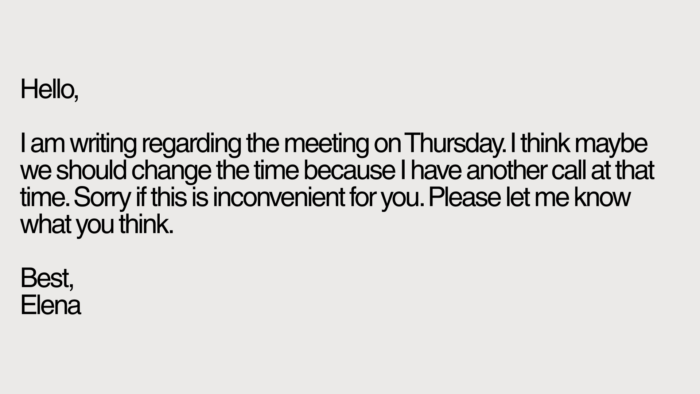
She looked at it and said: “It’s fine, right? But it doesn’t right – it’s not my voice. And I hate saying ‘sorry’. But I don’t know what else to put.”
What we didn’t do
I want to be clear about what didn’t happen next.
We did not:
- Drill grammar rules
- Study verb tenses
- Practise “more professional” vocabulary lists
- Compare her email to a “native speaker” version
None of those would have helped Céline because her problem wasn’t knowledge. It was ease.
What we did (three small shifts)
We looked at her email together. Not as something to fix. As something to add to.
Shift 1: Remove the unnecessary apology
Céline’s email contained “Sorry if this is inconvenient for you”. I asked her: “Is this true? Are you sorry? Or are you just used to apologising?”
She said: “I’m not sorry. I just need to move the meeting.”
So, we removed the apology. Nothing replaced it. Just silence where the sorry used to be.
Shift 2: Replace a weak opener with a clear one
“I think maybe we should change the time” → “I suggest changing the time”
No loss of politeness. Just more clarity. Céline worried this sounded too direct. I asked her to try it once. Just once.
Shift 3: Add a simple next step
“Please let me know what you think” → “Does 2pm work for you?”
Same request. But now the colleague had something specific to answer. Less work for them. Less waiting for Céline.
The revised email
Here’s what Céline’s email looked like after our conversation:
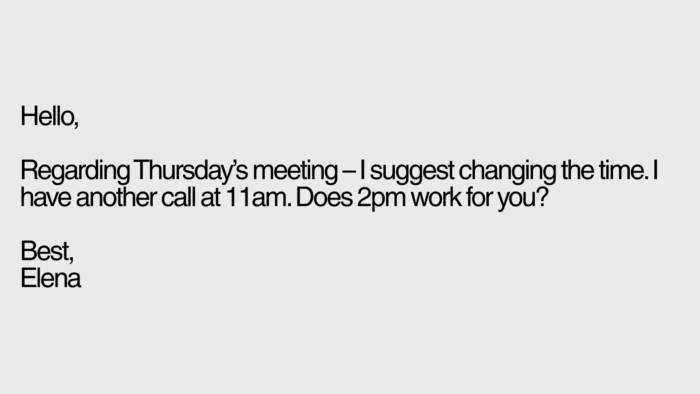
Same information. Same Céline. Just three small tools added.
The result (in Céline’s words)
She sent the email. Then she wrote to me: “I almost added ‘sorry’ three times. I didn’t. No one said anything. No one thought I was rude. The meeting got moved. That’s it.”
A week later, she told me: “I’m not writing perfectly now. But I’m writing faster. And I stopped apologising before I even start. And I don’t rely on AI to speak for me. That’s new for me.”
I realised that Céline hadn’t become a different English user. She’d became a lighter one.
What this taught me
Céline didn’t need more English. She needed:
- Permission to remove apologies
- One or two clear structures to trust
- Someone to say: “Try this. See what happens. No pressure.”
That’s what I mean by adding tools. Not fixing. Not correcting.
Just placing something useful in someone’s hand and saying: “You already have so much. Here’s one more thing. Use it if it helps.”
Your turn
Does any of this sound familiar?
- Spending too long on short emails?
- Apologising when nothing is wrong?
- Worrying you sound rude or unprofessional?
You don’t need more grammar. You might just need a few tools. And permission to try them.
A final thought
“You are not an email to be corrected. You are a person to be equipped.”
That’s how I work now. Not fixing. Adding.
- Let’s talk (no video, no fixing). If this resonated, I offer something simple: a free 15-minute Clarity Call – text only. We’ll look at one email. Or one situation. No fixing. No judgment. Just one or two small tools you can use this week. Book via my email.

